The Indoor Generation
What older generations don't get about the Gen Z appeal of the Backrooms

The following article contains spoilers for Backrooms the film and slight spoilers for Backrooms the YouTube series
What gives a person born in 2005 nightmares from 1994?
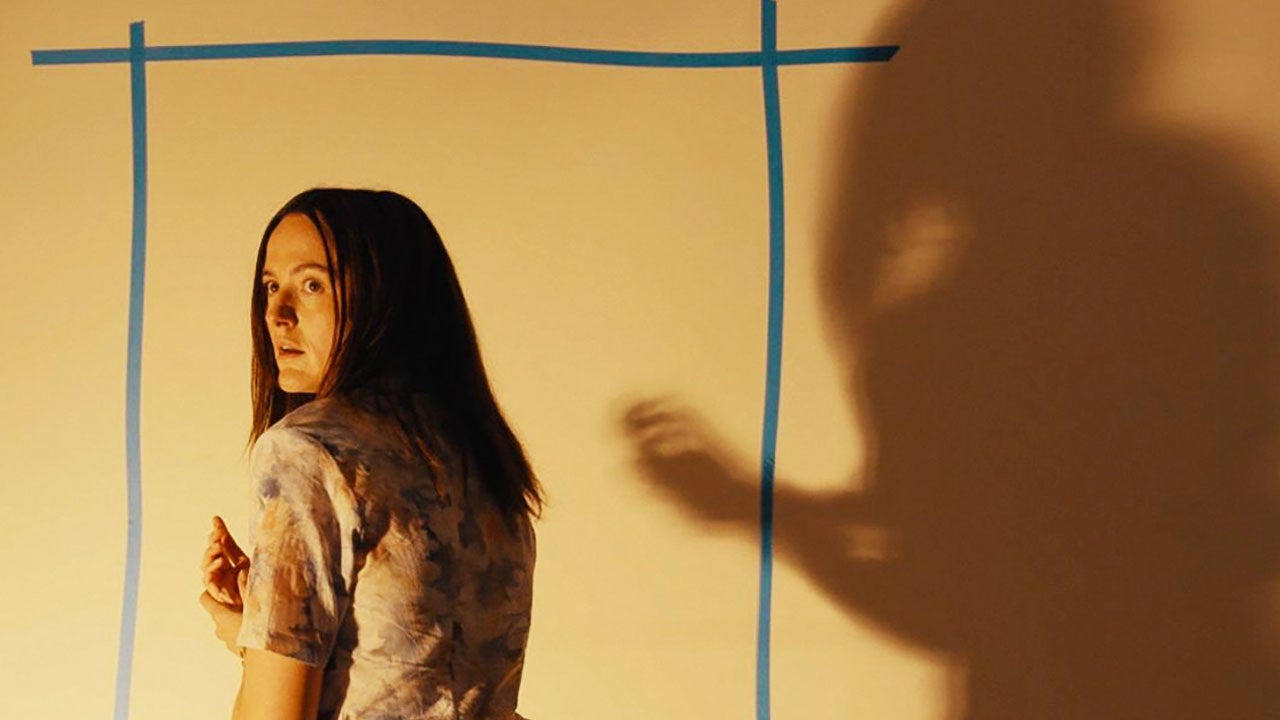
It’s among many questions my generation of jaded millennials have volleyed at Kane Parsons, the 20-year-old wunderkind who directed this year’s Backrooms film, based on his YouTube series. Backrooms sits squarely at the intersection of the three defining horror movements of this current decade: internet, analog, and liminal horror. In that sense it’s become a hotbed for us olds to argue about What It Means for the Zoomers that this is their modern The Exorcist, their ultimate folktale.
What I can personally say is that Backrooms is a very confident and entertaining horror film, one that proves Parsons has a much more interesting set of influences and ideas he’s drawing from than every single one of his YouTuber-to-filmmaker contemporaries. Even its more apparent flaws, primarily the pop-psychology dialogue from TV writer Will Soodik, pale in comparison to how they serve grander intentions of Parson’s vision, foregoing last decade’s trauma-horror tropes in favor of something less defined and more tantalizingly ambiguous.
So far, it seems the film is a hit with its target audience, at least according to the online chatter. However, I’ve noticed some (few but vocal) older critics are befuddled as to how the concept is even scary. Not everyone needs to understand what liminal spaces are to get Backrooms‘ appeal, yet the combination of the youth of its director and the material’s creepypasta origins seems to break the brains of millennial and Gen X tastemakers, probably best defined by this blunt tweet.
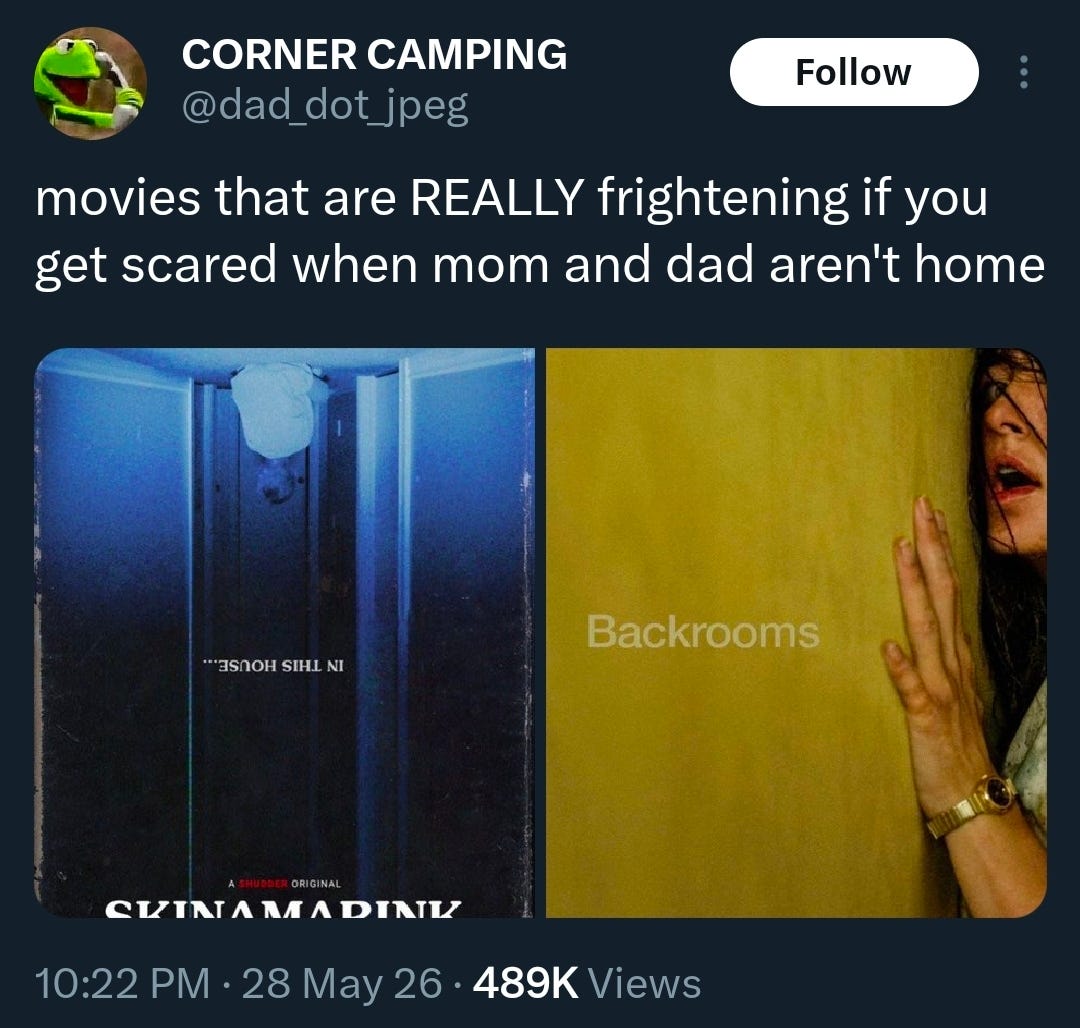
For those reading for whom images aren’t working, the author has posted the cover art for both Backrooms and the other internet horror breakout of the 2020s Skinamarink, and captioned it with “movies that are REALLY frightening if you get scared when mom and dad aren’t home.” Never mind the fact that Skinamarink is very specifically about childhood nightmares as interpreted through analog formalism, this user is right about one thing. Yes, Backrooms does evoke the primal fear of being alone without supervision, in a place easy to get lost in, familiar yet not your own when shrouded in dark (or in this case, yellow). But it’s like that not because it’s pointed at a generation who refused to grow up. No, no. This generation had been refused the right to grow up a long time ago. I know because, despite being a millennial, I am spiritually a zoomer in one key detail: I got a headstart growing up during quarantine.
While responding to another baffled tweet from an older colleague misinterpreting the origins of liminal media, my friend and fellow film critic Esther Rosenfield laid it out very simply:
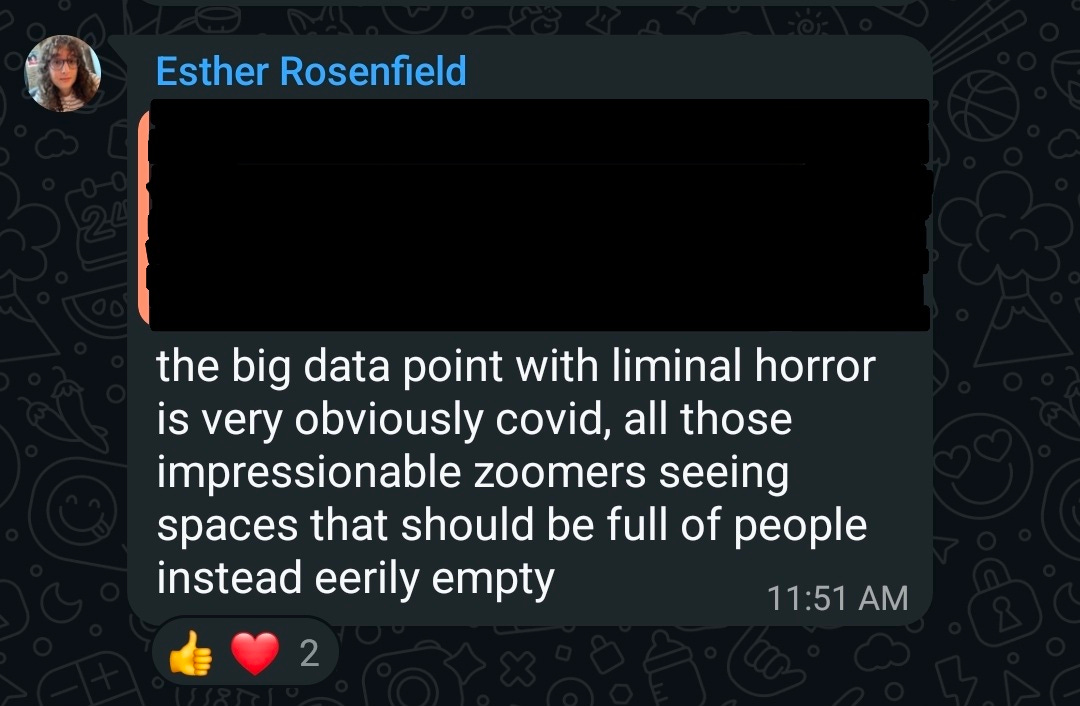
“The big data point with liminal horror is very obviously covid, all those impressionable zoomers seeing spaces that should be full of people instead eerily empty.”
She’s absolutely right. COVID scarred the mindsets of a generation of kids promised via Disney Channel sitcoms the quintessential American childhood of going to the mall with friends, all of whom found a much emptier reality waiting for them instead. They spent their time socializing online instead, imagining what kinds of monsters lurked in these dead shopping centers, what entity killed their American youth.
And so, myths like the Backrooms gave a version of the true answer: the space itself was always cursed. Monsters help, as in Backrooms‘ case, but just as many times, a monster isn’t even needed. The rot is embedded in that sickly yellow wallpaper. There are only monsters in there because we keep exploring these spaces, willing prey into a perfect hunting ground. The labyrinth of late capitalism, trapped with the Minotaur.
Parsons’ Backrooms makes its COVID paranoia very literal in just the right ways. Set in the greater San Jose area in the 1990s, the film is smart enough to know that the liminal eerieness of the Backrooms themselves is only creepy because reality itself already feels liminal. I’ve been to San Jose to visit family often. Parsons’ depiction is quite spot-on: a cultureless strip-mall purgatory with so little to do, you get why some characters refuse to leave the Backrooms at all. What’s waiting for them back home?
The cinematography by Jeremy Cox makes great pains to isolate its cast. The only time we see Renate Reinsve as therapist Mary socializing with anyone other than her patient Clark (Chiwetel Ejiofor) is during some kind of neighborhood party, and even then she’s never shot in wides or group compositions. She thinks back often to her childhood with a mother wracked with mental illness, one who barricaded the doors, papered over the windows, and ordered her young daughter to never go outside, otherwise they might getcha.
I was raised somewhat similarly by my own mother. She let us out of the house for school and play dates, but she controlled every aspect of our lives otherwise. We lived in a gated community, isolated from the rest of the world, and even within that gated community, we were never allowed to go beyond our cul de sac. If we were ever allowed to visit friends, it was always under very strict parameters and control. Not even other mothers could be trusted. What if they were child traffickers? What if we were allowed to walk alone on the street with nothing but a curfew and a van came to snatch us?
I’ve heard many times how I’d be kidnapped and sold in graphic detail, before I even turned 13. When that’s all you hear, you don’t wanna leave the house either. Anything can be out there.
In the case of the zoomers, they actually had something tangible to fear if they went outside. A deadly virus had laid waste to millions of people, and no one knew how to cure it. Anyone could die just from going outside. Yet staying inside wasn’t much safer, especially if you or the family members you’re stuck with forgot to wash your hands.
This same kind of paranoia is built into Backrooms‘ lore. As the Rooms have manifested, so too have the thresholds with which people slip through. In the original 4chan post, it was called “noclipping” through reality, like in a video game. In Parsons’ series, every hapless protagonist who finds themselves trapped in the Backrooms is there not through karma or even consequence. It’s pure unluck. One wrong step is all it takes and you’re trapped in an infinite maze.
When the Backrooms are discovered through sheer happenstance by the A-Sync corporation, the number of missing persons reports seems to increase across the country, as if these holes in our reality are spreading, the ground getting thinner and thinner. One video even shows an entire car falling through the road. Maybe in ten or twenty years, everyone will fall into the Backrooms. In that sense, the Backrooms are just as much a virus as they are a liminal space. You are just as likely to drop to your doom as you are to catch COVID.
The quarantine may have ended but the pandemic certainly didn’t. Somehow our society decided it was more important for the kids to finally go outside than waste away. They carry that decision with them now, wherever they go. Every time they try to hang out at one of the few surviving malls, pretending the space isn’t a shell of its former glory, they subconsciously must make peace with being born into a liminal world.
And in a liminal world, it’s hard not to dream about being born in another generation. The 90s aesthetic is baked into the Backrooms, the original 4chan photo itself was of a long abandoned furniture store from that era. Some people find these liminal spaces comforting, like they reflect a desire to disappear, to no longer be seen. Maybe the idea of a space cut off from our reality appeals to some part of our modern surveillance state culture. The nostalgia for a dead aesthetic is sickening, and yet it draws us in all the same.
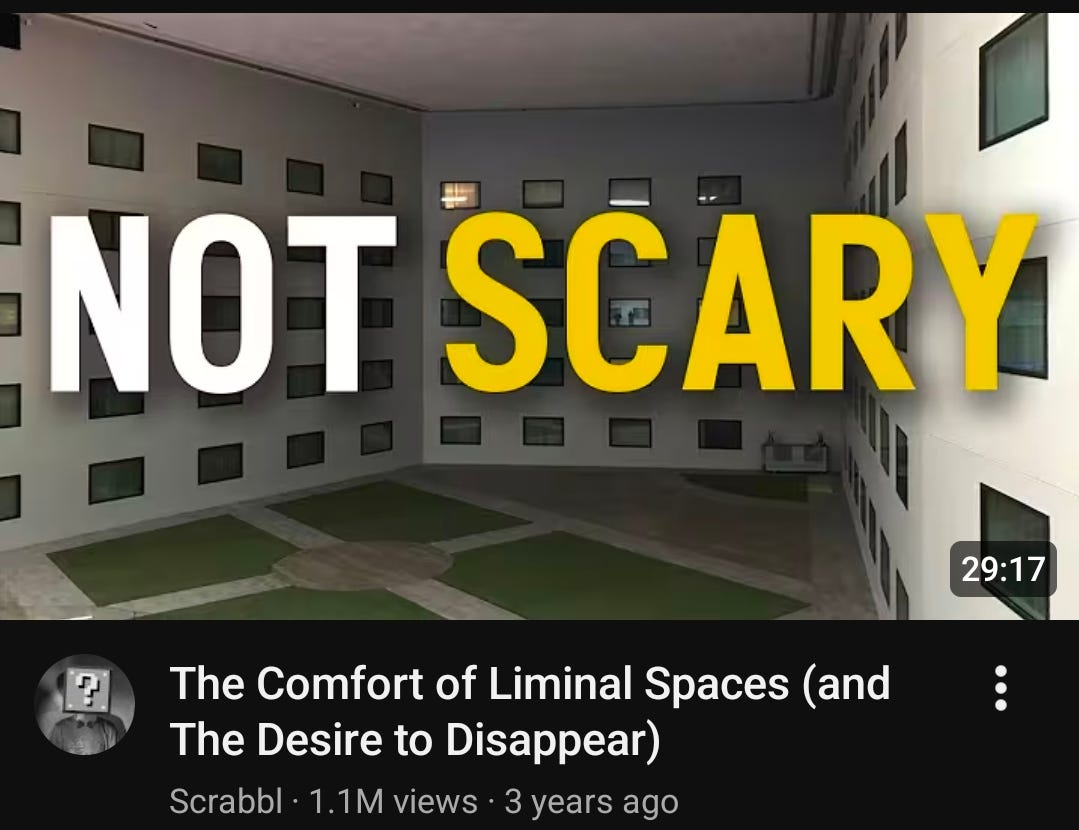
Parsons is self-aware enough to know he partakes in it himself by making analog nightmares. It doesn’t matter that he wasn’t born in the period of Hi8 video. Who wouldn’t dream of a pre-COVID, pre-9/11 world? Kane must’ve been about 11-years-old when Stranger Things season 1 premiered. The call to return to a world they never got to live in is baked into the media Gen Z grew up with. It wouldn’t resonate if their current world didn’t feel so dangerous and unpredictable to begin with.
And in an unpredictable world, we turn to therapy, a theme that Backrooms the film introduces to the series canon—specifically, the commodified facsimile of it versus the real thing. Reinsve’s Mary is successful enough of a therapist to have several published novels and audio tapes to her name, yet her methods and her soothing tapes fail to help Clark through his middle aged rut. My mom also had a fake therapist: Dr. Laura Schlessinger, who taught women to submit to their men over the radio. I listened to more Dr. Laura than I have my favorite bands. She was omnipresent in our daily car rides, always on the air, always giving advice to new callers. None of it seemed to help anyone.
It takes Clark going insane from spending weeks inside the Backrooms for Mary to finally give him the Real Thing, and even that doesn’t make him a better man, only more at peace with his brokenness. Some people refuse to fix themselves, but it doesn’t help when you’re surrounded by fake people.
Oh yeah, that’s right. Clark’s time spent in the Backrooms revolves around corralling the Rooms’ fake denizens, artless simulacra trying to recreate people it’s seen in the real world, and eating them to sustain himself. He is so enveloped in the Backrooms’ fake world that he is literally imbibing himself of it, letting it warp his perception of his relationships and faults until he’s been reduced to a parody of his former self.
I’m not the first person to make the comparison point that Kane’s interpretation of the Backrooms, since the inception of his YouTube series, is a metaphor for living in a ChatGPT era, an anxiety that crosses generations but is especially potent for zoomers just entering adulthood. The Backrooms, as an entity in itself, is but a living algorithm, taking all the data of our world, trying and failing to recreate it by spitting out uncanny replications. This has always been true of the environments themselves, but the film adds a newer wrinkle: that the Backrooms are also trying to mimic humans and coming up with grotesque distortions.
In that sense, Clark’s further immersion in this world is reminiscent of the modern phenomena of AI psychosis, people who are so enveloped in the hallucinations of large language models and algorithmic art that their perception of reality has warped. Clark himself even uses the Backrooms for therapy, to further convince himself he’s in the right regarding his failed marriage and stagnant job. He admits that he feels more like himself in there than he does back home. Maybe the Backrooms unveiled his true self, ugly and raw. Maybe he’s just not the same man anymore. The rooms, the algorithm, cares not for what it does to our minds.
When older industry execs, box office prognosticators, and Gen X film commentators look on in bafflement over Backrooms‘ appeal to millennials and zoomers, they are oft unable to parse that, despite its period trappings, Parsons has tapped into a truly modern horror shaped by our most immediate anxieties. Mark Duplass, who plays an older scientist studying the Backrooms in the movie, admits to not fully getting it himself. A man dedicated to researching the liminal space and even he remains in the dark.
He and the olds haven’t lived in the Backrooms Age like its target audience has. Even I, with my quarantining QAnon mother, can’t fully grasp the ways it reflects the Gen Z experience. But I think we all know where it leads. We no longer need the likes of radio psychologists or self-help books. The fake therapy will just propagate itself now.
The Backrooms are themselves the convergence of every post-COVID nightmare. An empty, fake world that has overtaken our own, slipping innocent bystanders inside until they are either subsumed in its reality or left dead by its hand. If it’s not the virus killing us, if it’s not the quarantine that made us go insane, then surely it’s the fake voices whispering into our ears, telling us to isolate from our friends and families, insisting we are special and unique and don’t need to change or move forward.
In a liminal world, there must come the liminal man. They may look and act like us, yet there is a lack we can perceive if not understand. Maybe one day, before we even realize it, an entire generation of liminal children will come, perhaps even outnumber us. Until then, we are left with this warning from our last non-liminal generation: the world is getting thinner. Sooner or later, we’ll all fall in.
I read your article before seeing the movie, and I do think this lens of the root of its horror is partially why I clicked with the movie so much. I referenced your article in my short Letterboxd review (https://letterboxd.com/mariahonmovies/film/backrooms-2026/). Thanks for writing this! :)
As a Gen Xer, I enjoyed a lot of Backrooms. After leaving the packed Saturday night London cinema, I felt it was just a bad Severance-lite escape room. I’m ecstatic for the results: critical, financial and mostly, for getting more people out to the cinema. Thank you for this poignant and informative article. Truly helped me to better understand how this film is resonating with Gen Z,A…..I don’t have to be the target audience for everything! I’ll continue to support new voices (I cannot wait for Camp Miasma!) and Obsession is my #2 film of 2026 so far. Sheep Detectives is #1, if that tells you anything.